
Mission Viejo Resident Lookup Coverage
The starting fact should choose the source. An address in hand points toward GIS maps. It also points to APN and tax rolls, survey records, and permits. A legal question points to the Orange County case gateway. Family history work leans on dated newspapers, obituaries, library databases, and archives. Whatever the entry point, the record proves less than the name suggests.
| Record | What it may confirm | Where | Access limit |
|---|---|---|---|
| Parcel and tax record | APN, situs, assessed values, exemptions, and a disclosed mailing context | Orange County Assessor, Tax Collector, GIS | Owner may be an entity, trust, former owner, or nonoccupant |
| Recorded document | Dated grantor or grantee role in a deed, lien, reconveyance, or other instrument | Orange County Clerk-Recorder | Index is free; image requires an ordered copy |
| Voter registration | Authenticated user’s status, mailing address, party, history, and districts | Orange County Vote | Self-lookup; controlled disclosure for qualified uses |
| Superior Court index | Case number, party role, filing, events, status, and public disposition | Orange County Superior Court | Visibility varies; a web entry is not the official file |
| Vital record evidence | Birth, death, or county-issued marriage event when access rules allow | Orange County Clerk-Recorder or CDPH | Certified copies are limited; informational copies do not establish identity |
| Business or license filing | Entity, agent, license, status, and disclosed professional affiliation | California SOS or DCA | Business or practice address is not home proof |
| Obituary or archive | Dated family, address, occupation, and community association | Mission Viejo Library, OCPL, archives | Historical evidence must be time-labeled |
Two sources answering two questions beat one source stretched thin. A deed can fix a transfer in time. A newspaper can place a family in Mission Viejo during a given year. Neither one should carry the weight of proving who lives in a house today.
Verify a Mission Viejo Resident Record
Countywide indexes are full of same-name collisions, so normalize the name before anything else. Search the full form and the middle initial. Try former or married surnames and reversed order. Bare initials and common transcription variants count too. Then pin the name to a place. An APN works as an anchor. So do a parcel situs, a court location, a business address, a school yearbook, a directory address, or an obituary place.
Time anchors the identity from the other side. A recording date can describe the same person at a given moment. So can an acquisition year, a court filing date, a license status date, an obituary date, a directory edition, or a voter status date. Demand two independent correspondences before trusting the match. An uncommon middle name paired with the same parcel beats a bare surname every time. An SOS agent address matched to a fictitious business name shows affiliation, not residence.
- Normalize every name form and list what is known versus assumed.
- Choose one place anchor and one date range before opening more portals.
- Run the narrow official index that fits the question.
- Compare a second source with a different custodian and record type.
- Inspect the underlying instrument or file when party role or disposition matters.
Orange County Court Name Search
Mission Viejo legal matters run through Orange County Superior Court. The public gateway splits into several categories. Civil Case and Document Access is one. Criminal and Traffic, Family Law, Probate, and Small Claims round out the rest. Free case-number lookup stands apart from the paid Name Search system. Name Search pricing runs in credit tiers. One credit costs $1.50. Five go for $5, and ten for $9. Seventy-five cost $70, while $400 buys unlimited thirty-day access. The court says searching your own name is free.
The authenticated Name Search fields are not itemized publicly, so no field list can be given. Start with the free category gateway. Then use a case number to move from the index into the proper division. Pre-online indexes sit at the Justice Centers. Lobby computers can show registers or permitted images that the public web never reproduces.
Open the Orange County Superior Court case-access gateway for current category choices. The separate Orange County Name Search portal carries the court's paid name-search route.
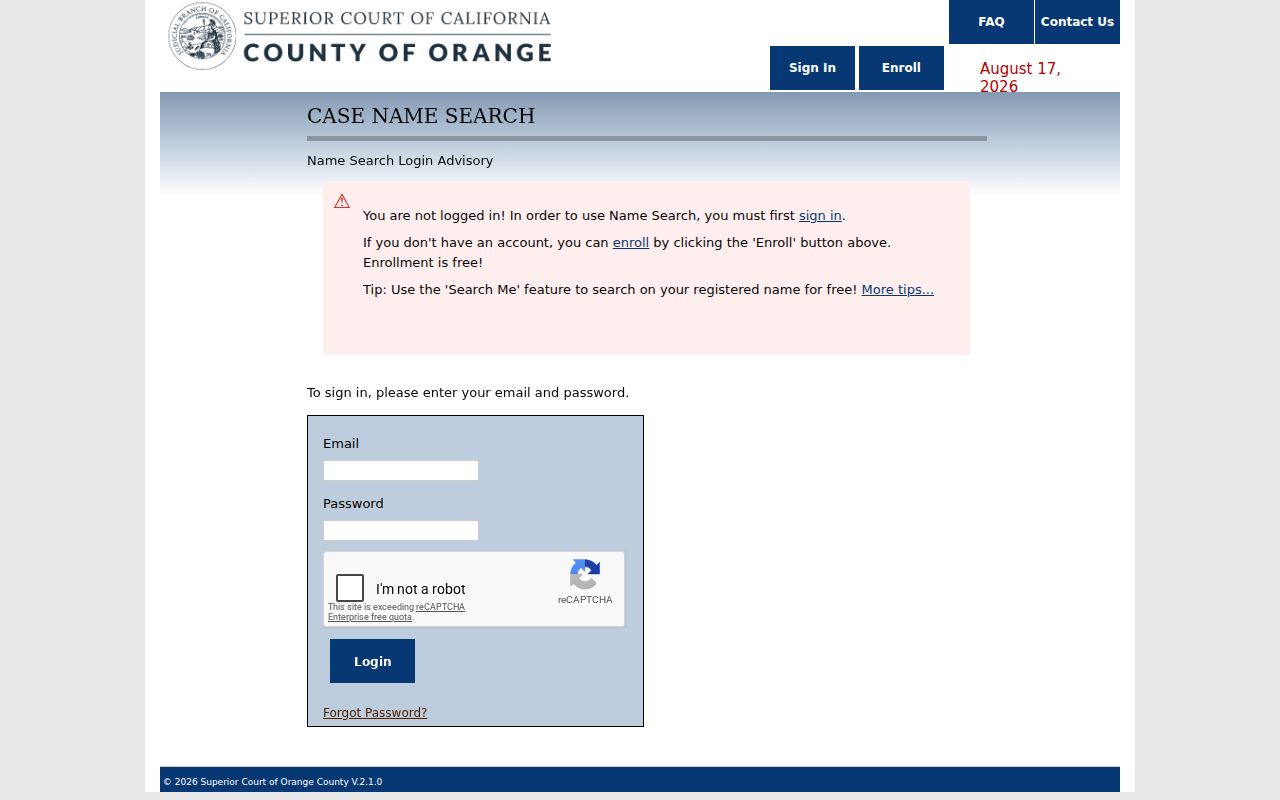
Begin with the gateway, not with a bare party name treated as a full identity record for a Mission Viejo resident.
Mission Viejo Court Result Fields
A court result is structured, but what shows up depends on the category: civil, criminal, traffic, family, probate, or small claims. Public systems support the field inventory above. A blank field can mean confidentiality, case type, or a document that was simply never imaged.
| Case number | The identifier used to request or inspect the proper file. |
|---|---|
| Caption and parties | Names and roles associated with the case, not a finding about any person. |
| Case type and filing date | The category and date that frame the record. |
| Status and courthouse | Current public status and assigned court location where shown. |
| Register of actions | Dated events and descriptions; the register is an index, not the full evidence. |
| Hearings and documents | Future or past hearings and public document titles or images where allowed. |
| Disposition or judgment | A public outcome where available; read the actual document and party role. |
- Docket
- The court’s case record or register, with dated entries that point to filings and events.
- Index versus image
- An index points to a record. An image or ordered copy contains the document text, subject to access rules.
- Certified copy
- A copy issued or authenticated by the custodian for an authorized purpose, unlike an ordinary informational copy.
Copy requests run through Form L-3009. It asks for the requester and contact, the Justice Center, case or citation, parties, the documents wanted and their date range, copy type, payment, and a signature. The court lists $0.50 per page, a $40 certification, and a $50 exemplification, plus separate search, divorce-decree, postage, and copy charges. Confirm current fees before mailing anything.
Verify Your Mission Viejo Voter Record
Orange County's voter tool wants a first and last name. It also asks for a date of birth. You can supply the last four digits of a California driver license or ID. An SSN alternative and a verification step complete the process. It exists to authenticate a person's own registration, sample ballot, ballot tracking, history, and districts. It is not an open third-party residents directory.
Controlled voter data opens a different door. The county application requires a wet signature, a declared statutory purpose, supporting documentation, and payment. Filters can narrow by district and registration-date range. Election history may be omitted, included in full, or limited to five listed elections. A history record proves how and when someone voted, never a candidate or ballot choice. Safe at Home and other protected records stay excluded or substituted.
Use the Orange County voter self-lookup only for the authenticated purpose the county describes.
Ownership Is Not Mission Viejo Residence
The Assessor's public form is built around the APN and leaves out the owner name. A parcel owner can be a trust. It can also be a business entity, a nonoccupant, or a past owner. A tax mailing address and a situs address answer two different questions. A homeowner exemption hints at occupancy, but it proves nothing on its own.
Recorded documents show grantor or grantee roles tied to a recording date. They can include a deed, deed of trust, lien, reconveyance, trust transfer, or court-related instrument. The Recorder index displays no images. The office will not run a title search for a requester. Identify the reference first, then order the copy when the conveyed interest actually matters.
Definition. A resident lookup asks who may be connected to a place or record at a time. It does not turn a parcel owner, agent, permit applicant, or voter match into a confirmed occupant.
California Vital Certificate Privacy
Orange County issues births and deaths that occurred in the county and marriage certificates for licenses it issued. The California Department of Public Health is the statewide channel. Births and deaths within the latest 60 days go to Orange County Health Care Agency. Certified birth and death copies are limited to authorized people under Health and Safety Code sections 103526 and 103526.5.
The 2026 county form distinguishes authorized and informational copies, lists applicant and subject names, event date and place, parent birth names for a birth, marriage parties, relationship, signature, sworn statement, and notary fields. An informational copy is stamped as not valid to establish identity. California does not use a simple “closed for a fixed number of years, then public” rule for modern certificates. Adoption originals remain sealed absent the statutory or court process.
See the Orange County vital-record information before relying on an index or ordering a copy.
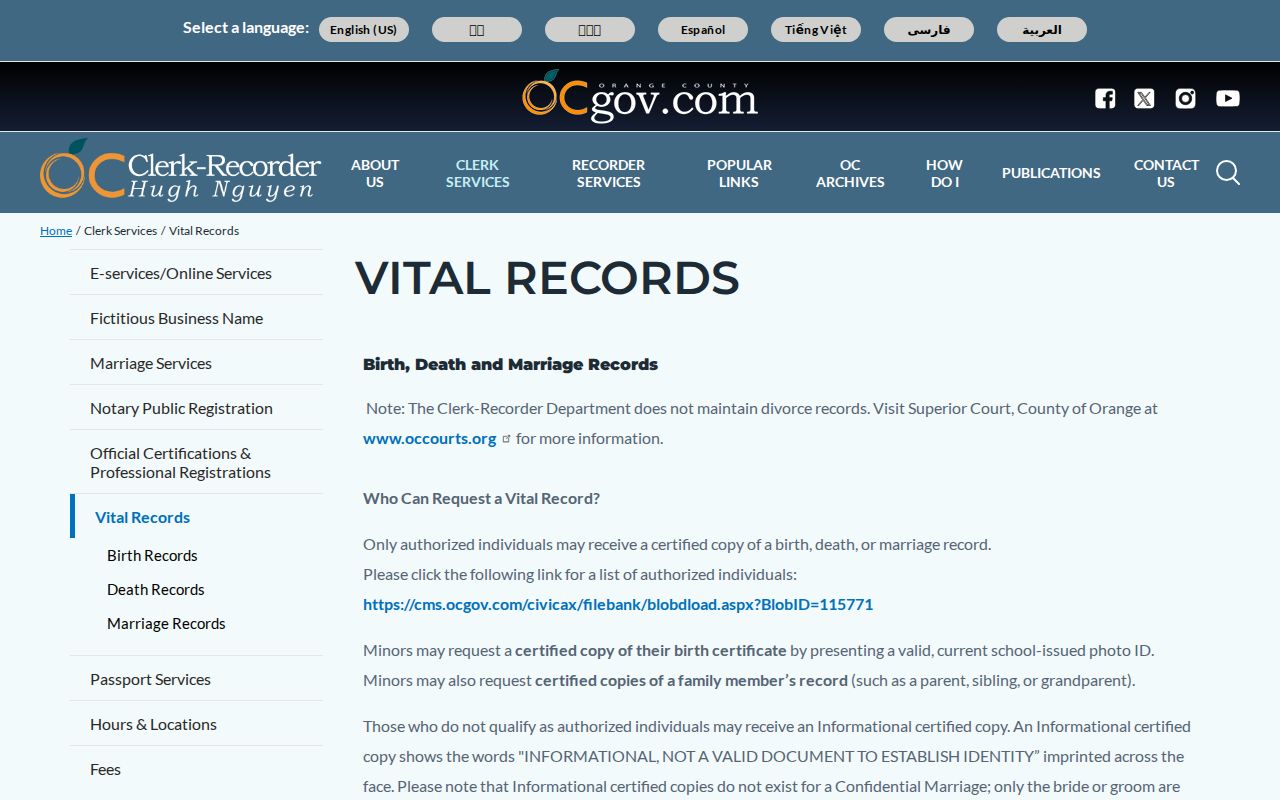
A vital record proves an event for someone entitled to ask. It is not a free name database for modern Mission Viejo residents.
Find Heirs and Former Classmates
Work by category instead of running one broad search. For an heir, start with Orange County probate case access. Get the decedent and case number, then request the public petitions, notices, and orders. Check the personal representative or heir wording against a deed and an obituary. Addresses inside filings are dated and sensitive, so handle them with care.
A birth parent or adoptee should go through California's official adoption-information process. The CDPH rules cover amended and original birth records. Adoption files stay confidential. A public-record request from an unrelated person cannot substitute for consent or a court order. For a classmate, yearbooks pin down the historical name. School and library collections, alumni publications, and newspaper archives help too. Remember that a yearbook shows who sat together, not where anyone lives now.
A past family connection needs a source shelf. The Mission Viejo city-directory collection route pairs well with library newspapers and obituaries.
Business and License Affiliations
The California SOS bizfile can display an entity's name, number, formation date, status, jurisdiction, street or mailing address, agent, statement due date, and filing PDFs. The State Controller's unclaimed-property tool can surface a holder-reported name and city. That is often enough detail to begin a claim. Treat both as affiliations or leads. Neither one proves a home address.
DCA license searches differ by board. Many show license type, number, original issue date, expiration, status, address, and discipline indicators. An agent for service just accepts legal process. That does not make the person an owner or resident. Plenty of business, practice, and mailing addresses sit far from anyone's front door.
To chase a possible unclaimed-property lead, open the California State Controller search. Submit identity proof only through the official claim process.
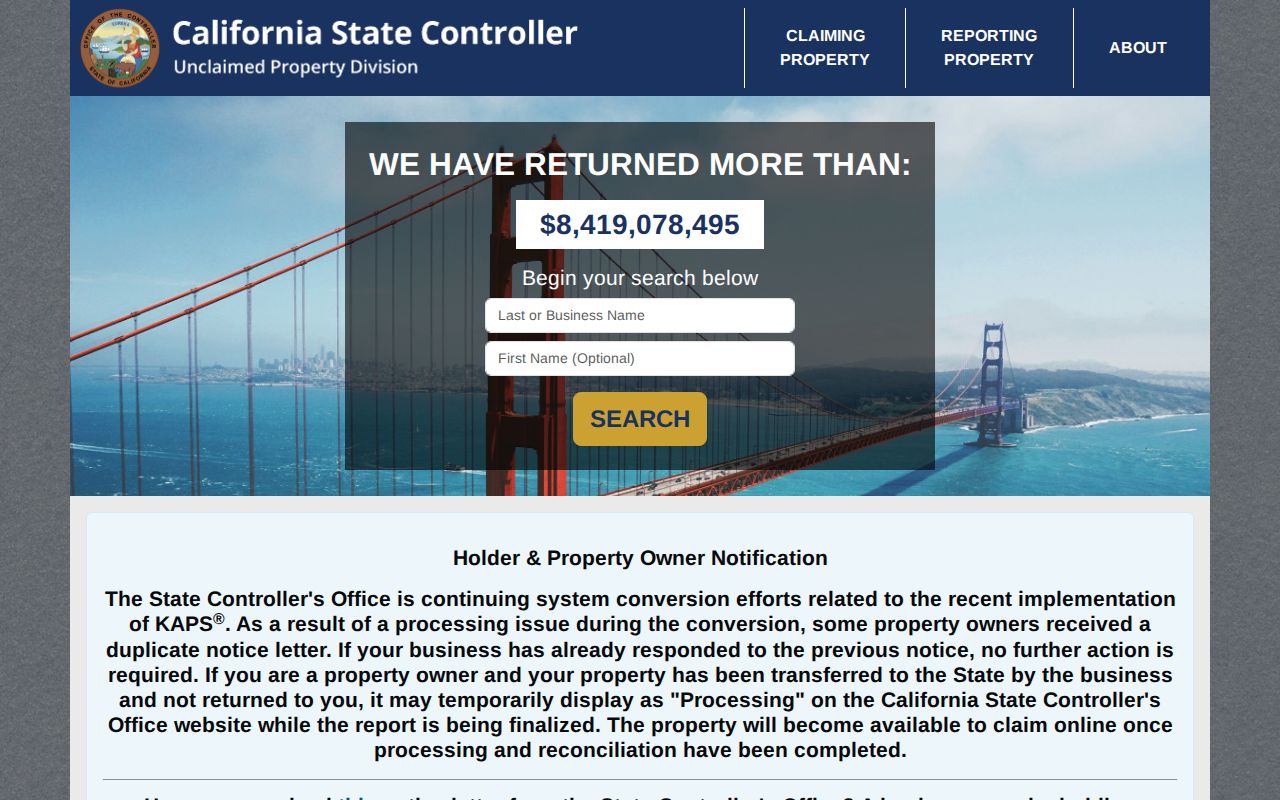
A Mission Viejo city label on an unclaimed-property result may just be an old reporting address. Corroborate it with a dated record first.
Narrow California Name Portals
Some official portals answer exactly one question. The CDCR Incarcerated Person Locator searches state-prison records by last name or CDCR number. Orange County runs its own Sheriff custody search. It handles county jail matters. California's Megan's Law site publishes only what statute allows. Anti-harassment limits are attached. None of these is a general Mission Viejo residents directory.
Each result has edges. The CDCR locator is informational. It can differ from the official file. A jail result reflects current custody or booking, never a full criminal history. A registry result demands attention to its exclusions and use warnings. For copies, corrections, or questions, go straight to the exact custodian.
Open the California incarcerated-person locator to see the narrow state search route.
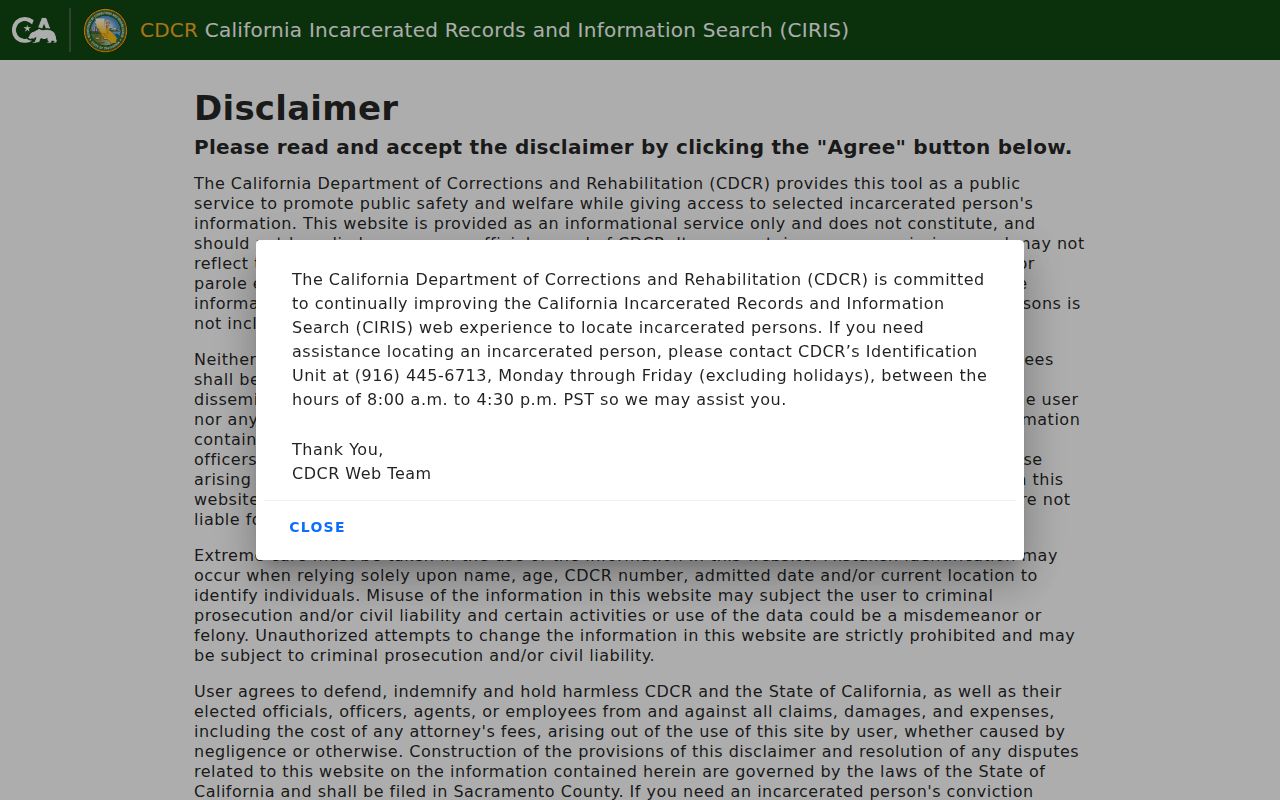
A narrow official tool earns its keep when the category fits. It misleads when its result gets treated as a universal identity file.
The California Megan's Law public site is another category tool with statutory exclusions and anti-harassment limits.
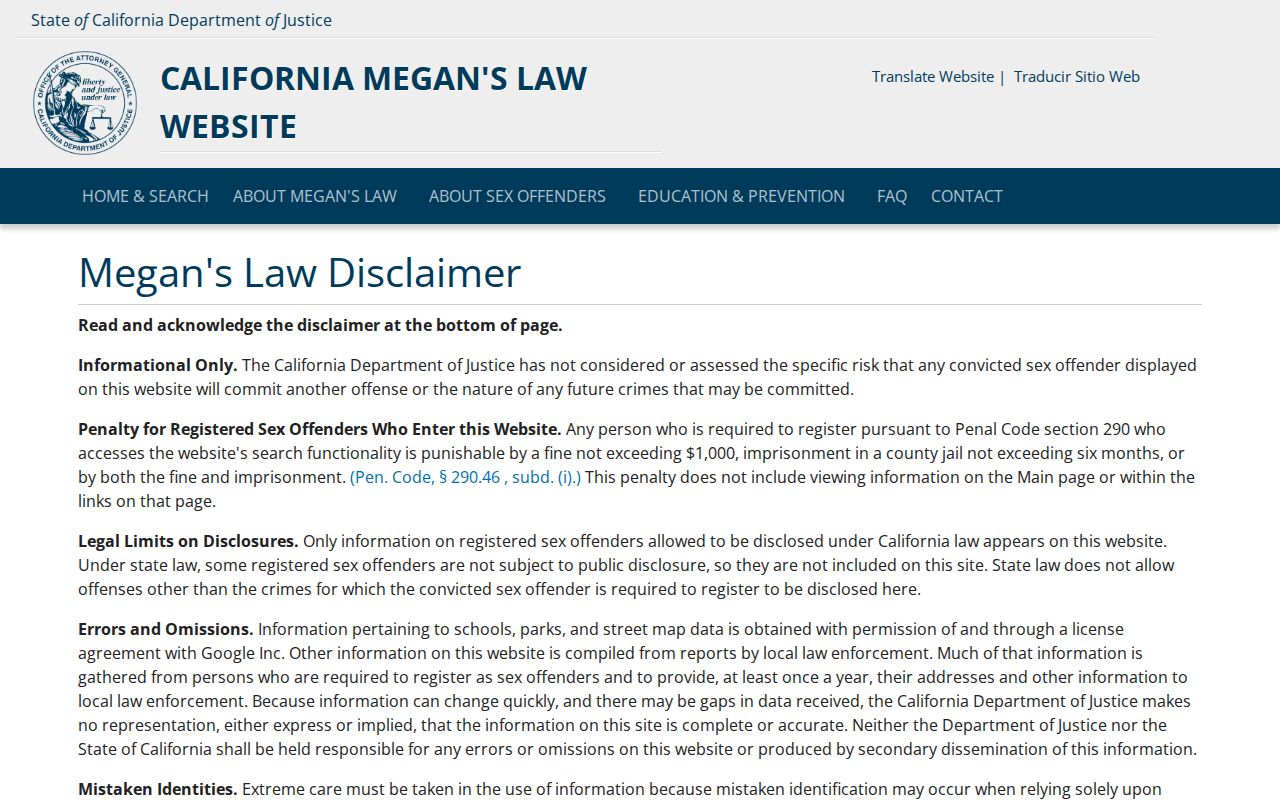
A registry result must stay within its publication rules. Never stretch it into an unsupported identity claim about anyone in Mission Viejo or elsewhere.
Correct the Custodian’s Record
No search site can rewrite a court, deed, voter, vital, or license source. Corrections belong with the office that created the record. That office follows its own amendment, appeal, or correction process. For a city administrative record, describe the existing record and the office. Include the date range, the address or APN, and the electronic copy you want. The California Public Records Act opens access to identifiable existing records. It does not force an agency to answer a research question. It does not require a list to be built or an exempt record to be released.
A negative result means little on its own. The record could be confidential, indexed under a different spelling or entity, or outside the portal's digitized years. It could also be held at another level of government. It may never have been created at all. Save the search date and exact source. That way the next person can reproduce the check. They will not inherit a shaky conclusion about any Mission Viejo resident lookup.
Limits on a Mission Viejo Resident Lookup
California runs a Safe at Home program for eligible survivors and certain at-risk workers. It gives them a substitute mailing address with forwarding. That protection is real but narrow. It hides where someone lives, not the fact that they exist in public files. So a resident can still show up in a Mission Viejo resident lookup through a deed or business filing. But a protected home address stays sealed away from view. Voter rolls, DMV records, vital records, adoption files, sealed cases, and juvenile matters all sit under special restrictions. Each of these has limits of its own.
Treat a lookup as a tool for a specific question. Ask the records office to confirm anything you plan to rely on. And if a result points to a protected person, stop there.
Lawful use. A resident lookup is for lawful personal research, genealogy, and record verification. Never use a name, address, court, voter, or license result to stalk, harass, intimidate, or harm anyone.